



Bengaluru, March 21 – Chief Justice of India, Justice Surya Kant, articulated a clear vision for the integration of Artificial Intelligence (AI) into the nation’s judicial framework on Saturday, insisting that its role must be to fortify the institution without usurping its fundamental responsibilities.
His remarks came during the inauguration of a dedicated one-day seminar titled “Artificial Intelligence-Prevention and Resolution of Disputes,” held at the Karnataka Judicial Academy. The event was a collaborative effort, bringing together the UIA India Chapter, the Bar Association of India, and the National Law School of India University, according to an official communiqué.
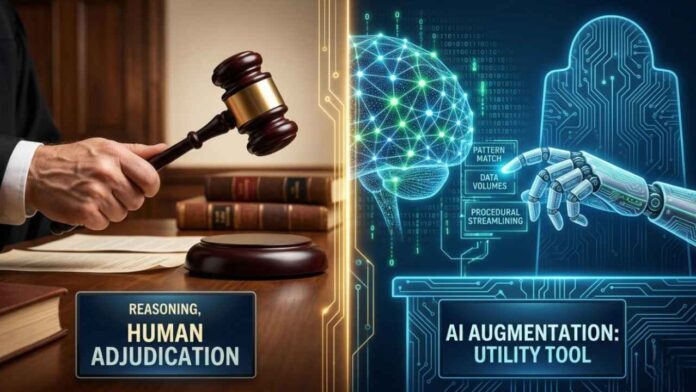
Justice Kant delineated AI’s beneficial applications, stating, “AI’s utility lies in assisting with the management of extensive data volumes, discerning patterns, and streamlining processes to alleviate procedural backlogs.” He swiftly added a crucial caveat: “Nonetheless, it is imperative that AI does not intrude upon the judiciary’s foundational duty of rendering judgments.”
The Chief Justice issued a stern warning against allowing AI tools to dictate judicial outcomes, emphasizing that such a reliance could severely undermine both transparency and accountability inherent in the justice delivery mechanism.
He underscored the non-negotiable principle that the ultimate phase of adjudication must unequivocally remain under human purview.
“The culminating act of the judicial journey, the pronouncement of judgments, must be held firmly by human hands,” he reiterated. He elaborated that judges are bound to leverage their inherent reasoning, accumulated experience, and acute analytical prowess when formulating and issuing verdicts.
Affirming technology’s role as an empowering agent, Justice Kant clarified that AI’s function is strictly that of a utility. “AI should serve merely as a tool or a conduit,” he explained, “with the overarching direction and purpose always being dictated by human intellect.”
Concurring with the sentiment, Karnataka High Court Chief Justice Vibhu Bakhru, also present at the seminar, voiced his own apprehension regarding AI’s expanding footprint within the judiciary. He posed a critical question: would AI consistently serve as an auxiliary to human judgment, or would it gradually morph into a replacement, thereby eroding the fundamental role of judges?
Justice Bakhru proceeded to outline both the promising opportunities and inherent perils. He acknowledged AI’s potential to facilitate predictive analysis in disputes and substantially boost operational efficiency. Furthermore, he recognized that online dispute resolution platforms, augmented by AI, could offer a quicker and more economical avenue for case resolution.
Crucially, he underscored the necessity for robust safeguards. Judicial independence, absolute transparency, and adherence to legal principles, he asserted, must remain non-negotiable tenets, dictating that AI’s deployment within the legal system be strictly governed by explicitly articulated guidelines.
Adding another perspective, Prashant Kumar, President of the Bar Association of India, highlighted a tangible benefit: AI’s capability for swift translation of court judgments into various regional languages. This, he noted, significantly enhances accessibility for rural populations and empowers lawyers in their interactions with clients.

